notes on installing apache 2.2.6 for cygwin
That took forever and the solutions were scattered about. Oh yeah, I’m doing this in Windows XP Pro.
Started with Cygwin’s setup.exe.
Tried to start Apache and got this:
httpd: Could not reliably determine the server’s fully qualified
domain name, using tms-computer.local for ServerName
(48)Address already in use: make_sock: could not bind to address
0.0.0.0:80
no listening sockets available, shutting down
Unable to open logs
This was solved by changing the Listening setting (line 40 of etc/httpd.conf) to 85 since another service was using 80.
I read several accounts of people clean restoring their machines to get an open listening socket. Don’t do that!
Let’s see, what was the next problem? Oh yes, this at the very bottom of the same http.conf file:
#BEGIN PHP INSTALLER EDITS – REMOVE ONLY ON UNINSTALL
PHPIniDir “C:/prog/PHP/”
LoadModule php5_module “C:/prog/PHP/php5apache2_2.dll”
#END PHP INSTALLER EDITS – REMOVE ONLY ON UNINSTALL
I don’t currently have PHP installed, and if I did install it, it wouldn’t be to that location. Perhaps this will cause some problem later, but for now it fixed things enough for me to get to the next problem…
Now, feeling pretty good, I was following these instructions, starting with Test since Cygwin had taken care of everything up to Customize and I had taken care of that already.
Of course, running
$ usr/sbin/apachectl -k start
did not work.
I got the following error:
/usr/sbin/apachectl2: line 78: 2340 Bad system call $HTTPD -k $ARGV
After a fair amount of poking around and trying things that did not work, I found this page, which got me back on the right track.
You have to have cygserver installed.
I swear I had done that before, but I did it again. Details on cygserver are here.
Run usr/bin/cygserver-config
When it asks you if you want to install as a service, say yes.
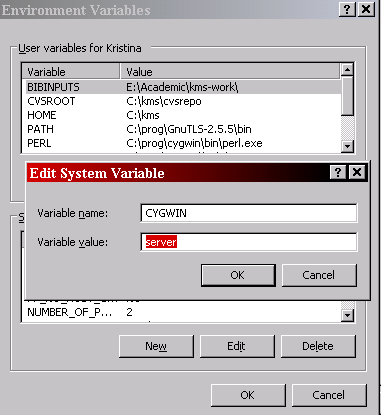
Set a global Windows environment variable: CYGWIN=server
To do this, right click on any “My Computer” you see and select Properties >> Advanced >> Environment variables.

Make sure you are in the system variables and not the user variables.
Start the cygserver service:
net start cygserver
HA! This must be it…
Try this again:
usr/sbin/apachectl -k start
STILL it didn’t work! Argv indeed.
I forget where I even found the answer, but the answer was to type in this instead:
CYGWIN=server usr/sbin/apachectl -k start
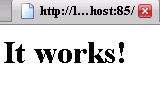
and FINALLY:

the right idea, but…
Max Van Kleek; Michael Bernstein; David R. Karger & mc schraefel. (2007) “Gui — phooey!: the case for text input.” In UIST ’07: Proceedings of the 20th annual ACM symposium on User interface software and technology, pp. 193-202.
Abstract: Information cannot be found if it is not recorded. Existing rich graphical application approaches interfere with user input in many ways, forcing complex interactions to enter simple information, requiring complex cognition to decide where the data should be stored, and limiting the kind of information that can be entered to what can fit into specific applications’ data models. Freeform text entry suffers from none of these limitations but produces data that is hard to retrieve or visualize. We describe the design and implementation of Jourknow, a system that aims to bridge these two modalities, supporting lightweight text entry and weightless context capture that produces enough structure to support rich interactive presentation and retrieval of the arbitrary information entered.
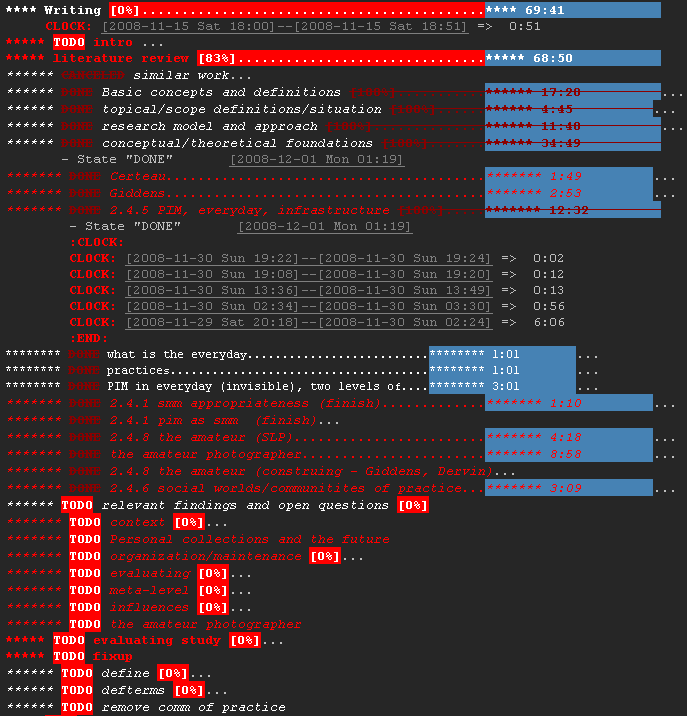
I already have this. It is called Emacs org-mode with org-remember-insinuate.
Oh snap, I just saw that there is an org-mode <–> Freemind converter. must not play must not play must not play
Do you know how much I love Emacs?
No, you really have no idea…
perhaps those who say i work too much have a point.
I have worked diligently on writing, looking up page numbers in articles, and verifying citations for just over 36 hours since Friday morning. A tad over 12 hours a day. And here I was excoriating myself for not getting started earlier in the day(s).
Every 5-10 minutes I am stopping myself from writing a paragraph that isn’t necessary, so imagine how bad it could be.
can haz squished.
OK, this is me, working in my messy office:
Let us examine the place of the silly cat in my work setup…
advice
Lots of advice on writing on ask metafilter.
The focus is on how to overcome perfectionism.
Not that anyone I know has ever had any issues with that… *whistles*
more music for writing, or, netlabels are a grad student’s best friend
I downloaded a bunch of stuff recently and have been slowly working through it while working on my dissproposal. I recommend:
What we really like about the album is that it’s almost impossible to characterize it in a matter of specific musical genre or style. This is the music which can be depicted in such terms as “good” or “attractive”, or “visionary” or “surreal” but not “rock”, “hip-hop”, “glitch”, “negerpunk” or whatever is usually on your iPod/Winamp.The album starts with a deep, vibrant sound which reminds me the final dark electronic period of Coil magiciansmusicians. But soon the music turns into some sort of Tribal-Folk with a heartbreaking chorals, freakish oriental drum patterns, and blurred sitar/string melodies which flows in an endless ocean of acoustical noises. The more you listen to this epic ballade-intro, the more you realize that “GLitch ov Batumi” will settle down in your mp3-player for a long time. On the “Irenashvili djan” song you’ll have to deal with catchy overdriven acid flavored oriental broken beats a-la Muslimgauze. And on the “Mountings” you’ll be drowned in a deepest lake of abstract ambient. And the comprehensive title of “Drummers ov God” song needs no additional comments, I believe.
Also enjoyed today: Kittenhead, by Djinnestan, but I don’t know how much it would pull me in if it weren’t called KITTENHEAD:
In many ways, it defies easy categorization. It is very ambient, but contains rhythms. It is dark, yet at the same time whimsical. It includes acoustic instruments and vocals, but they have been processed virtually beyond recognition.
And finally, last night, I described the songs Inland and Track 2 by Cisfinitum to Will as “magnificently creepy.” More about Cisfinitum, via Wikipedia:
Cisfinitum’s leader and inspirer Eugene Voronovsky has graduated from the Moscow State Conservatory as a professional violinist. In his music he uses classical instruments such as violin, piano and percussion along with the sounds traditionally considered “non-musical”, like sound of mechanical coffee grinder or dying man’s breath, all of this subjected to thorough processing, in which both Soviet analog tools and modern digital processing technologies are used. That’s why Cisfinitum can be called the industrial-ambient reading of academic music.“Cisfinitum is the sound of eternity. I’ve always wanted to create the music of Russian cosmos, music capable of expressing information about Russia that is impossible to reveal by means of words. They call this ‘drone’ overseas, but I prefer to define it ‘metaphysical ambient’”, claims Eugene.
And I called “magnificently creepy.” That’s a good thing.
resolution.
Comps defense: PASSED.
Not really surprising, but it feels great.
Had a lovely lunch with my advisor and a committee member, stopped by Weaver Street Market on the way home for a bottle of cava for later this evening, took a nap snuggled up with my cats, and am now ready to get back to work.
I don’t know what in the world my brain was doing while I was asleep, but I woke up feeling a little depressed and frustrated by this quote which I’m quoting from p. 1949 of: Cronin, Blaise and Lokman I. Meho. 2007. Timelines of creativity a study of intellectual innovators in information science . Journal of the American Society for Information Science and Technology 58 (13) 1948-59.
“scholars in information science tend not to have significant extrafield impact (Cronin & Pearson, 1990).”
Why is this, and how could it be changed? Guess I should read the Cronin and Pearson article and see what else they said…
The other thing in my head was “What exactly is ‘human geography’ and why do I find the papers from that field so intriguing?” Then I thought of the notion of information geography, what that might be, and whether anyone is doing anything they are calling by that name. The Gooracle brings up this from the Department of Geography at University of Washington, which isn’t exactly what I was thinking. But I’m not sure exactly what I was thinking. Not a trail to run down right now, though… I have a couple of other things to do. Just a few.
excitement.
Oral comps defense imminent.
At 11 am EST. (Early for this 2am-10am-natural-sleep-schedule owl… ouch)
I must finish my protein-ful (and coffee-ful) breakfast and get out the door.
(also, emacs and I have begun a beautiful relationship. it’s about time. mmm AUCTeX. mmm Org mode.)
yes. oops.
How to Survive Your PhD: Everything You Need to Know on One Page
by David Gauntlett
But by his timeframe I’m soooo in trouble.
Meh.
writing.
Despite the awkward state of my literature review’s grammar and spelling,1 I am quite concerned with writing well. Being an academic is no excuse for being utterly boring. Says the cataloging teacher…
I am now writing my proposal and I noticed I am repeating words: summarize, describe, review. This reminded me I have been meaning to compile an academic writing cheat-sheet: lists of useful active verbs organized by relationship, lists of what not to do (common wordy phrases, favorite terms that I use too much), lists of commonly misused words, etc.
I found a good starting point for the first at University of Toronto Scarborough:
Verbs in academic writing [pdf]
Verbs for citing sources [pdf]
Adjectives and adverbs for academic writing [pdf]
Useful Sentence Stems for Summary and Critical Review [pdf]
Link Ideas in Your Sentences Effectively [pdf]
I want to plug another good resource for academic writing that I certainly never considered before a few months ago: the university writing center.
It felt utterly bizarre to start going to UNC’s Writing Center last spring. It was not my own idea. Honestly, I was highly resistant to the idea. I’ve always thought of myself as a good writer. I was that kid bored out of my skull in English class, doodling or surreptitiously reading a book. And then I made 100s on all the quizzes and got recommended for the school newspaper staff and literary club. Everyone seemed to expect that I would become a writer of some sort. When I switched my undergraduate major from English to Commercial Art, someone suggested I was disappointing God by not using the special gift he gave me. This same person years later learned about the concept of “paradigm” and suggested we lived in two different ones. I’ll say.
Why did I go to the writing center? I was clearly completely stalled on and overwhelmed by my literature review. Recently gained data clearly explained why all my old tricks weren’t working, why they wouldn’t ever work, and why I had such trouble following all the good academic writing advice out there. I needed help figuring out some new strategies.
Kim Abels at the Writing Center is absolutely wonderful. I met with her regularly for a few months. It was very helpful to discuss with her in detail my entire research writing process, from source identification through reading, note taking, outlining (or lack thereof), drafting, revising, and polishing. She immediately identified the pattern causing most of my trouble and gave me a range of practical strategies to experiment with counteracting that pattern.
The most helpful strategy for me was this:
- Identify how long you can work steadily (or in my case, how log to work before forcing yourself to take a break to actually move your legs, focus your eyes far away, and go to the bathroom). I settled on 50 minutes.
- Break the paper down into pieces you think you can complete in that period of time.
- Each piece should be a section, group of paragraphs, or even just one paragraph
- Make a list of sections, set a timer, and attack the first section. Desperately try to finish. Make it a game.
- When the timer rings, stop. Even if you are not done. (I was rarely done.)
- If you did not finish, add that section back to the end of your list.
- Take a break, then come back and take on the next section.
- Repeat as necessary
I later ran across this same sort of idea under the name “time boxing,” and yep, it addresses my main problem: the compulsive need to work on any project for all available time. It prevents realizing the day before it is due that you’ve only written the first quarter of a paper that you’ve been working on for three weeks. Yes, I’ve done that. But not any more…
So, the point of all this is if you are struggling with academic writing (there can be a million reasons why, and it is not always “butt not in chair”), most universities have valuable resources that can help you for free. Even for grad students. Even for faculty. Even if you are a Good Writer. Especially if you are a Good Writer, since most of us Good Writers have never had to stop and think about any part of our writing. And then we get to grad school…
If you have been spinning your wheels on writing, go to the writing center. The people there have read everything on writing (the research on the writing process, writing how-tos, etc) and they know a million strategies for helping with any writing problem.
Oh, and if you are in the social sciences, read Writing for Social Scientists: How to Start and Finish Your Thesis, Book, or Article by Howard S. Becker.
- My advisor strongly suggested I turn it in without the final proofread because she knew it would take me a week to closely read and correct the thing. And that I probably couldn’t leave it alone… [↩]