
Month: January 2009
trucs
Tonight I am thinking about teaching. Specifically, pedagogical patterns and Testable, Reusable Units of Cognition (TRUC).*
I’m also thinking about why I always gravitate to the abstract and high-level views of things instead of the practical applications of things. Well, it’s how my brain works. But I’d be better served (in the short term) by writing down topics and readings for week slots than thinking about design patterns for teaching.
-=-=-=-=-=-=-=-=-=-=-=-=-=-=-=-=-=-=-=-=-=-=-=-=-=-=-
* Very awkward to make this plural. TRUCs = Testable, Reusable Unit of Cognitions.
voice.
Tonight I’m thinking about voice and person in academic writing. I’ve been struggling with choosing and sticking to a particular style.
Research was conducted.
I do not care for the high formal academic style: invisible or distant, third person, inactive researcher/author, passive voice. It pretends at an objectivity that never exists, and it requires all manner of unnecessary words, clauses, and convolution to maintain the curtain of author/researcher invisibility.
I’m used to it in papers on experimental / quantitative research, but I’m always pleased and refreshed by other approaches to composition in such reports.
I did some research.
When I do research, I come up with questions. I decide how to investigate them by designing studies. I make assumptions, reason, and come to some conclusions. My ideas, theoretical lenses, and analysis drive the research. I cannot escape all of my blind spots and biases or pretend they do not exist.
If I have done my job well, the data does not represent me, but my participants. Except, I have to remember that, in much qualitative research, the data doesn’t exist until a researcher starts poking around, observing, and asking people questions. I can’t forget my influence on the data.
It feels dishonest to erase my own voice as researcher and author by writing up such work in high formal academic style. It feels like posing in a costume of objectivity. It also does the reader a disservice by not making explicit my role in the research. The researcher is the primary research instrument in qualitative inquiry; therefore, the results of inquiry cannot be evaluated if the researcher is absent and non-reflexive in reporting.
That said, I tire of repeated Is; they can read as self-centered, narcissistic. The study is not about me. If I start with I, I’m currently seeing no graceful, sensible way to minimize my glaring presence aside from casting the text as an actor. “This paper describes…” “The following section presents/argues/discusses…” That only gets you so far, and definitely not far into the methodology/methods. Further, you must be careful to avoid nonsense like “This paper studied…” I’m sure the drafts I currently have open are riddled with that nonsense.
Feelings.
I have been trying to place my reaction to some of the academic work I’ve run across recently. Case in point:
Leitch, R. “Outside the spoon drawer, naked and skinless in search of my professional esteem: the tale of an “academic pro”” Qualitative Inquiry, 2006, 12: 353-364.
On one hand, the author’s experience in some ways resonates with my own. Thus, I felt some sense of validation and encouragement reading the paper. On the other hand, I felt a sort of irritation and another negative feeling I can’t quite label yet. At one point, I put the paper down and thought, “Why is this published? This is personal journaling material. It is not appropriate to read about this woman crying over her keyboard in a journal that publishes serious and useful methodology and methods papers.” Perhaps the feeling is embarrassment? I’m not sure.
The paper was presented as an exploration of personal experience. I have similar but lesser reactions to some passages reporting qualitative studies. Written in a certain way, explanations of why a topic was chosen, certain questions were asked, or assumptions were made leave me feeling like I’ve non-consensually been pulled into the authors’ group therapy session. Likewise for the papers containing sections about how the researcher felt during the conduct of the study.
The information contained in these passages is required for understanding the study and influences on the results. The trouble for me is that there seems to be a fine line between being reflexively present and honest as a researcher/author, and writing touchy-feely and processy stuff that (to me) belongs in a personal research journal or blog—not in a journal article or book chapter.
I don’t think I’ve figured out how to trace that line without crossing it. The more I write the pronoun I, the more I feel I’m in danger of slipping over.
We are not amused.
I could have sworn that at one point I posted here about we, but I can’t find it.
One of my pet peeves is the single-author article, riddled with we, that displays no explicit statement of team research (or the identities of team members). It is distracting, much like the use of any pronoun with no clear antecedent. Who is this mysterious we? I imagine the author in Queen Victoria drag or as the spokesperson for some secret cabal.
It is I.
So, given my foundational assumptions about the nature of research and my sense of the proper usage of English, it seems I’m stuck with I. So I need to start paying more attention to clever composition tricks useful for avoiding litanies of I statements.
I am a bit concerned about how writing in the first person singular may affect response to submitted articles. I know that I see articles in first person singular in the literature, but I do not have a good sense of the prevalence of usage overall or by specific well-regarded journals. Now I want to throw all other work aside and start a discourse analysis of the LIS literature combined with a survey asking authors to reflect on their use of voice and person.
Note made. Distraction avoided.
As this post nears 1000 words…
I am also committed to writing as simply and concisely as possible without over-simplifying ideas. My natural tendency is toward verbose rambling, so this is a long term challenge.
I’m now also being tempted to avoid pressing work by going through my article file to see if I can find papers by authors writing in a voice that I like. Models are good.
Suggestions of academic authors you consider to be good scholarly writers are welcome. I’m starting a list.
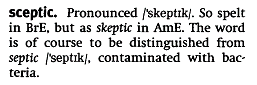
Finally, a bit of writing advice for everyone from The New Fowler’s Modern English Usage:
new feature.
With this post, I announce a new feature of this blog.
No, it is not posting more than once every two weeks, or posting anything of real substance.
I will begin collecting small scale category/classification schemes that I find amusing or interesting.*
A prize to start the collection… from a story about an MLA conference panel about sex at the MLA conference** that Simon tweeted:***
Many presenters at the MLA use categorization to make their points, and this session was no exception. Jennifer Drouin, an assistant professor of English and women’s studies at Allegheny College, argued that there are eight forms of conference sex (although she noted that some may count additional forms for each of the eight when the partners cross disciplinary, institutional or tenure-track/non-tenure track, or superstar/average academic boundaries).
1. “Conference quickies” for gay male scholars to meet gay men at local bars.
2. “Down low” sex by closeted academics taking advantage of being away from home and in a big city.
3. “Bi-curious” experimentation by “nerdy academics trying to be more hip” (at least at the MLA, where queer studies is hip). This “increases one’s subversiveness” without much risk, she said.
4. The “conference sex get out of jail free” card that attendees (figuratively) trade with academic partners, permitting each to be free at their respective meetings. This freedom tends to take place at large conferences like the MLA, which are “more conducive” to anonymous encounters, Drouin said.
5. “Ongoing flirtations over a series of conferences, possibly over several years” that turn into conference sex. Drouin said this is more common in sub-field conferences, where academics are more certain of seeing one another from year to year if their meetings are “must attend” conferences.
6. “Conference sex as social networking,” where academics are introduced to other academics at receptions and one thing leads to another.
7. “Career building sex,” which generally crosses lines of academic rank. While Drouin said that this form of sex “may be ethically questionable,” she quipped that this type of sex “can lead to increased publication possibilities” or simply a higher profile as the less famous partner tags along to receptions.
8. And last but not least — and this was the surprise of the list: “monogamous sex among academic couples.” Drouin noted that the academic job market is so tight these days that many academics can’t live in the same cities with their partners. While many colleges try to help dual career couples, this isn’t always possible, and is particularly difficult for gay and lesbian couples, since not every college will even take their couple status seriously enough to try to find jobs for partners. So these long distance academic couples, gay and straight, tenured and adjuncts, must take the best academic positions they can, and unite at academic conferences. “The very fucked-upness of the profession leads to conference fucking,” Drouin said.
Sad, sad, sad…
The comfort is that, much like the job market in LIS is not much like the job market in the humanities, my (albeit limited) experience has been that our conferences aren’t much like MLA.
And if I’m wrong, don’t correct me. I like this illusion. Seriously.
-=-=-=-=-=-=-=-=-=-=-=-=-=-=-=-=-=-=-=-=-=-=-=-=-=-=-
* Ok, so this probably doesn’t really count as a new new feature, given that I’ve been posting interesting or amusing subject headings and classes on this blog for ages.
** How meta! We like meta around these parts.
*** Will I ever be able to talk about Twitter without a smirk? Maybe one day it will not seem ridiculous to talk about tweeple tweeting. I mean, circa 1999 or so, “Google” sounded pretty ridiculous, right?